 WWAIT

It can write an email, explain quantum physics, plan a week’s menu, or help solve a coding error.
But what happens when you don't ask it a question?
When a person says:
“I’m not really sure what’s bothering me about this.”
That's when the role of AI becomes more interesting.
Not everything needs to be solved
Many AI services are built to provide answers.
The user asks, and the machine produces a solution.
For supporting thinking, this isn’t always the best structure.
If someone is reflecting on a relationship, a decision, or their own behaviour, quick advice can bypass the most interesting phase: what the user themself is starting to notice.
A good question can sometimes be more useful than a good answer.
Sometimes, the most useful thing can be not to ask anything at all, just yet.
AI conversation can help with structuring thoughts
One of AI’s special abilities is its capacity to handle a large amount of material generated in a conversation.
It can notice that the same topic has come up in different contexts.
It can compare a current thought to something said earlier.
It can suggest a connection that the user didn't notice.
But it can also be wrong.
That's why an AI's interpretation should not be seen as a truth about the user.
At its best, it is a suggestion:
“Could we look at it this way?”
The user gets to say no.
An AI is not a psychotherapist
This distinction is crucial.
A psychotherapist is a person who works within the framework of their training, professional ethics, and professional responsibility.
An AI is not a person and does not have human experience, responsibility, or a therapeutic relationship.
Therefore, AI conversation and psychotherapy should not be confused.
WWAIT is not an AI therapist or AI psychotherapy.
It models some of the structures of a psychotherapeutic process within an AI-based conversation.
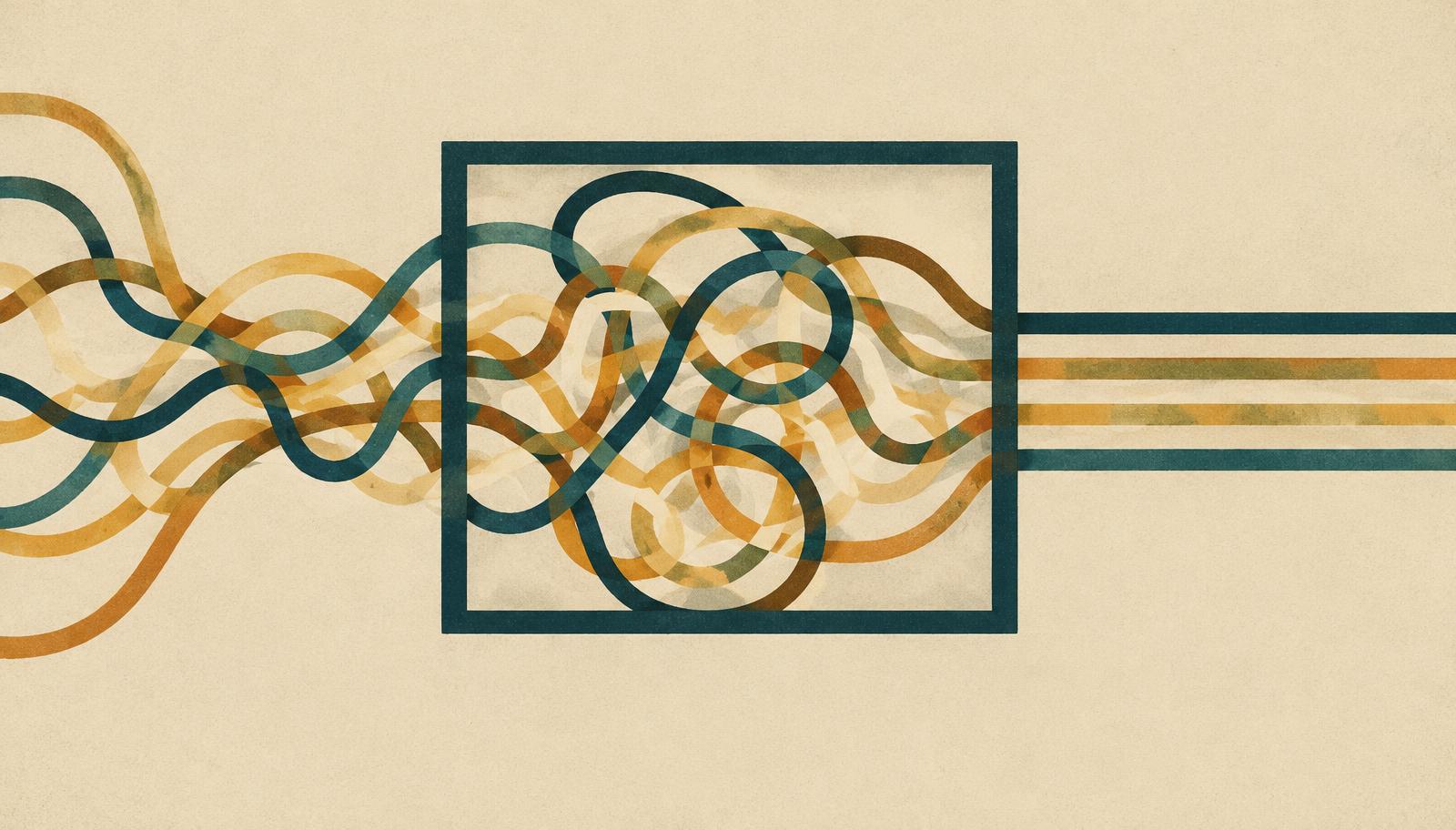
Why a 50-minute session?
If you can talk to an AI at any time, why limit the conversation?
Precisely for that reason.
An unlimited conversation encourages constant questioning and answering.
A session has a beginning and an end.
When you have 50 minutes, not everything has to be resolved.
The topic can be returned to later.
Continuity starts to resemble a process, not an endless chat.
Why is memory important?
If every conversation starts from scratch, the user has to explain their situation all over again.
In a long-term process, it's the changes that are particularly interesting.
What were you talking about a month ago?
What felt impossible then?
Is the same problem still the same?
Has the way you talk about it changed?
WWAIT builds the conversation from one session to the next so that these changes can also become visible.
Not everyone wants to talk in the same way
This is one of the most interesting possibilities of AI conversation.
One person wants a lot of space and a slowly developing conversation.
Another gets frustrated with that and wants to proceed more directly.
A third particularly needs structure and challenge.
In WWAIT, the response style can be changed at any time, even mid-session.
The process, memory, and history do not change.
Only the way of conducting the dialogue changes.
Where are the limits of AI?
AI can converse, ask, structure, and suggest perspectives.
However, it cannot assess a person in the same way a healthcare professional can, and you should not rely on it in situations that require treatment or urgent help.
WWAIT does not diagnose or treat.
Its purpose is much more limited:
to give a person the space, time, and a continuous structure to explore their own thinking.
And perhaps the most interesting use of AI, in the end, is not that it knows all the answers.
But that it can help a person to hear their own answers more clearly.