 WWAIT
How WWAIT works
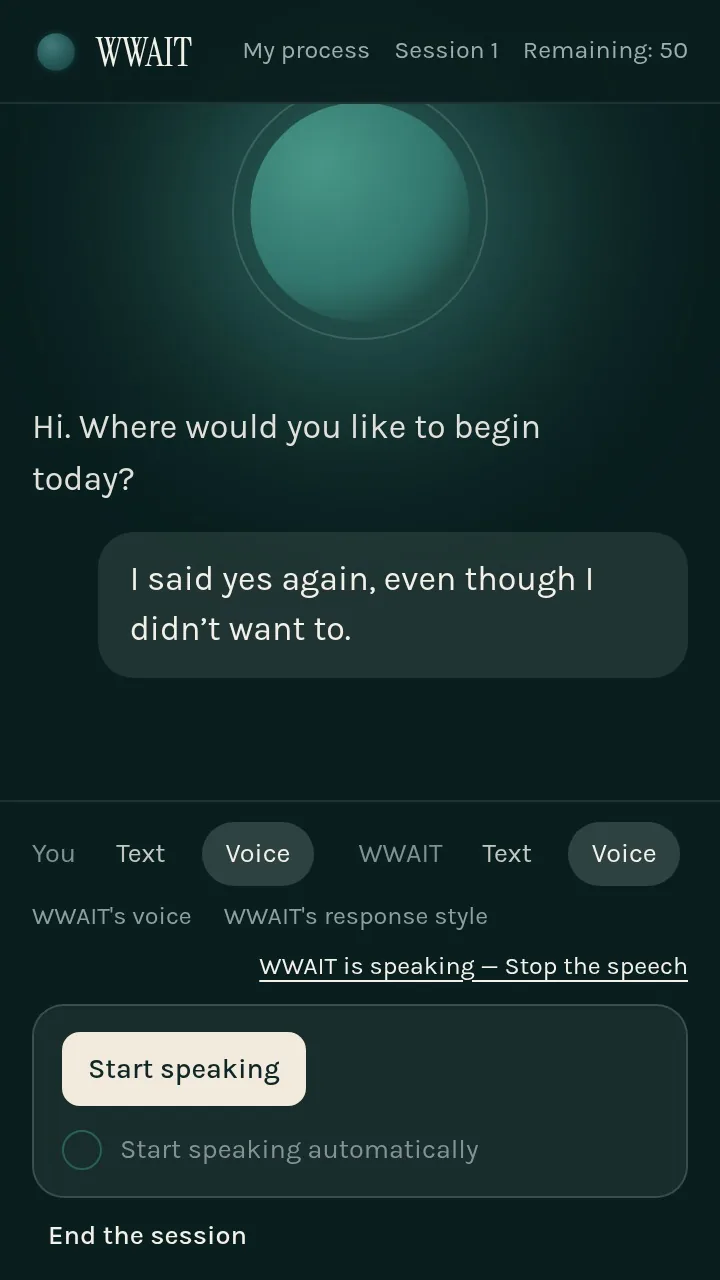
In WWAIT the conversation happens in sessions. Each session has a time frame and an ending, but what is said in it is not scripted in advance.
Below we explain how sessions are structured and how the work carries on from one session to the next.
- 1
You bring the content
A session can start from whatever is on your mind right now. You don't have to know in advance what to talk about or where the conversation should lead. - 2
WWAIT holds the process
WWAIT follows no ready-made list of questions and no predetermined therapy protocol. Drawing on the conversation, earlier sessions and the process, it judges which next step makes sense right now.Sometimes it asks. Sometimes it reflects what it hears. Sometimes it returns to something you said earlier. Sometimes it notices a connection, a contradiction or a recurring pattern.Not everything has to fall into place at once.
- 3
Sessions form a continuum
WWAIT does not treat each session as a new conversation. It retains essential understanding from previous sessions for the sake of the process and uses it in later conversations. For example, it may return to something you shared earlier, identify recurring themes over time, or notice that something has changed. In this way, individual sessions can gradually form a longer process. The backbone of the process is regular Regular sessions agreed in advance: one to four sessions a week, at the rhythm that suits you. The time between sessions is not empty as far as the process is concerned. What came up in a session — experiences, thoughts, contradictions — can keep settling in its own time: you notice yourself and your life, meet new situations, and arrive at the next session with new experience. More talking therefore does not automatically mean a better process. - 4
Understanding builds slowly
WWAIT does not lead you down a predetermined path and does not try to resolve everything within one session. Understanding builds gradually from what you bring to the process yourself.If it feels afterwards as though nothing in particular happened, that does not mean the process hasn't begun. Some things only become visible through time, repetition and several sessions.The aim is not to find quick answers, but to understand step by step what is happening in you and in your life.
- 5
The session has a frame
A session does not go on indefinitely. The time frame helps the conversation become a whole.WWAIT knows where in the session you are and takes that into account as the ending approaches. But the conversation is never forced into predetermined phases just because time is passing. - 6
Choose how WWAIT works with you
Not every situation calls for the same kind of dialogue. Sometimes it helps to slow down and explore something in depth. At other times you may want to move faster or have things laid out more clearly. In WWAIT you can choose a Natural, Deepening or Structuring response style and change it at any time – even mid-session.Deepening lingers longer on what you share and draws connections. Natural replies quickly and naturally, moves smoothly and takes earlier parts of the conversation into account. Structuring pulls together what matters and clearly challenges your thinking forward. Changing the response style does not restart the process. Earlier sessions, memory and the continuity of the conversation stay in place. The style you chose last also carries over to your next session.The same process, a different way of holding the dialogue.
Your goals. Your experience.
Whether WWAIT is useful to you is ultimately for you to judge.
At the start of your first regular session, you can note down, if you wish, what you hope to get from WWAIT and how you would know it has been useful. You can also rate how well you feel able to work through the thoughts and questions that matter to you.
After every session you can leave feedback. About once a month you can rate again how you organise your thoughts and how far you feel you have come towards your goals.
Your goals and ratings appear on the My process page, so you can follow for yourself how your experience changes over time.
We also ask whether you have been able to draw your own conclusions and whether the conversation has felt like it steers your thinking in a particular direction.
We want to develop WWAIT so that it supports independent thinking, new perspectives and the user's own insights.
All questions are optional. They reflect your own experience – they do not assess your health, make diagnoses or measure treatment outcomes.
Detailed instructions for using the session and working with voice are in the user guide.
Read the user guideWWAIT never speaks over you
You decide when your turn ends. In speech you can pause, think and stay silent for as long as you need. WWAIT answers only once you hand it the turn. A pause does not mean you are finished. Silence here is not a gap that needs filling. It can be part of thinking. Sometimes the thought that matters only arrives after a short pause, when you don't have to hurry to answer or keep the conversation constantly moving. WWAIT's task is to leave room for that.